

Life Preserving Services
Download the information on this page as a PDF
- Scroll down for LPS requests and agreements and LPS FAQs
- Download: Understanding the LPS process (2025 version for NZNO delegates and members)
- Download: NZNO guidance for Life Preserving Services during strike action
- Download: LPS one pager
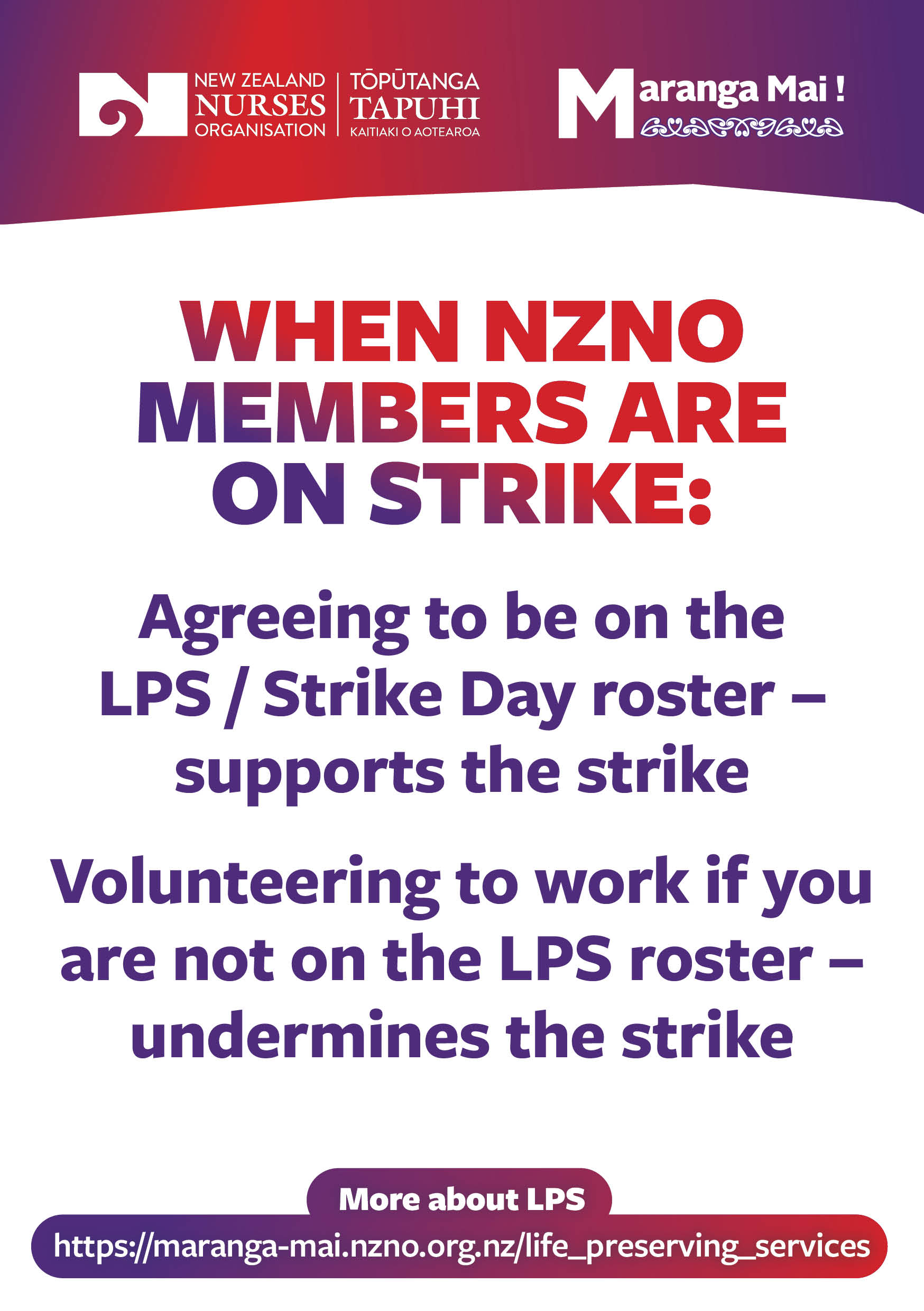
- Download: "When NZNO members are on strike" flyer
- Download: "When NZNO members are on strike" flyer in English-Tagalog-Hindi
- Strike FAQs are here
- Download the document: Advice about LPS and your right to strike
Daily drop in sessions for delegates and members 12-28 November
- Drop in sessions for delegates will be held from 10-11am every weekday from 12-28 November. The link for the daily delegate sessions at 10-11am is here.
- Drop in sessions for all members will be held from 3-4pm every weekday from 12-28 November. The link for the daily all member sessions at 3-4pm is here.
During NZNO strike action at Te Whatu Ora the employer is legally required to provide Life Preserving Services. The employer’s obligation to provide Life Preserving Services is outlined in the Employment Relations Act 2000 Code of good faith for public health sector.
The employer may request that a striking employee provide life preserving services. “Life preserving services” means crisis intervention for the preservation of life; care required for therapeutic services without which life would be jeopardised; urgent diagnostic procedures required to obtain information on potentially life threatening conditions; crisis intervention for the prevention of permanent disability; care required for therapeutic services without which permanent disability would occur; urgent diagnostic procedures required to obtain information on conditions that could potentially lead to permanent disability.
If an employer believes if cannot arrange to deliver any life preserving services without the assistance of union members, it must make a request to the union seeking the union’s and its members agreement to maintain or assist in maintaining life preserving services. Such an agreement if reached is not a legally binding contract, but an agreement which may be assessed for remedies that flow from a breach of good faith.
If an agreement is reached it must be recorded in writing. If an agreement is not reached (as here), an adjudicator must provide a determination which is binding on the parties. The parties must use their best endeavours to give effect to the determination. The word “parties” refers to the employer and the union (not the employees).
The union members themselves possess the right to determine whether they will participate in a strike. The union may not require an employee not to strike. Individual members possess the right to determine whether they will participate in a strike.
The union can undertake to use its best endeavours to give effect to the adjudicator’s determination but it cannot be required to go further.
The union’s best endeavours obligation arises in the context of life preserving services so as to ensure the safety of patients in extreme circumstances. The union’s position is as follows:
- You cannot be compelled to break or breach the strike by either the union or employer for the purposes of life preserving services.
- You possess the right to determine whether you will participate in the strike(s).
- If you are asked to redeploy to another ward or work additional hours you should seek advice and support from the delegate or the union.
- We will assist to ensure that the request is genuine and for a legitimate reason.
- We will assist by discussing ethical obligations and any code of ethics, including obligations owed to existing patients.
- We will advise on your right to strike.
The union will be educating managers as to the crucial importance of avoiding the misuse of life preserving services for reasons of convenience.
Download the document: Advice about LPS and your right to strike
Scroll down for our Life Preserving Services FAQs.
Life Preserving Services agreements - Safe Staffing strikes 17-30 November
Please see below for the LPS requests from Te Whatu Ora for the Safe Staffing strikes, as well as the adjudication outcomes.
Despite NZNO members and delegates negotiating the LPS requests with Te Whatu Ora, agreement was not reached across the motu. Te Whatu Ora referred the matter for adjudication. This process is defined by the code of good faith when agreement cannot be reached. The Chief medical officer of each district invited both parties to present their points of difference and the related rationale. The CMO must attempt to resolve any differences between the parties to enable them to reach agreement and, if that is not possible, make a determination binding on the parties. The adjudication hui, one for each district, took place on 8/9 November. The adjudication outcomes for each District can also be viewed below.
- NPHS Northern Region LPS request
- NPHS Northern Region adjudication outcome
- Te Tai Tokerau LPS request
- Te Tai Tokerau adjudication outcome
- Waitematā LPS request
- Waitematā adjudication outcome
- Te Toka Tumai Auckland LPS request
- Te Toka Tumai Auckland adjudication outcome
- Counties Manukau LPS request
- Counties Manukau adjudication outcome
- Waikato LPS request
- Waikato adjudication outcome
- Bay of Plenty LPS request
- Bay of Plenty adjudication outcome
- Lakes LPS request
- Lakes LPS adjudication outcome
- Tairāwhiti LPS request
- Tairāwhiti adjudication outcome
- Taranaki LPS request
- Taranaki adjudication outcome
- Whanganui LPS request
- Whanganui LPS adjudication outcome
- Hawkes Bay LPS request
- Hawkes Bay LPS adjudication outcome
- MidCentral LPS request
- MidCentral LPS adjudication outcome
- Wairarapa LPS request
- Wairarapa LPS adjudication outcome
- Capital and Coast and Hutt Valley LPS request
- Capital and Coast and Hutt Valley adjudication outcome
- Nelson Marlborough LPS request
- Nelson Marlborough adjudication outcome
- Canterbury LPS request
- Canterbury adjudication outcome
- South Canterbury LPS request
- South Canterbury adjudication outcome
- Te Tai o Poutini West Coast LPS request
- Te Tai o Poutini West Coast adjudication outcome
- Southern LPS request
- Southern adjudication outcome
Advice about Life Preserving Services and the right to strike
Life Preserving Services FAQs
- What is Life Preserving Services (LPS)?
During Te Whatu Ora strike action the employer is legally required to provide Life Preserving Services. The employer’s obligation to provide Life Preserving Services is outlined in the Employment Relations Act 2000 Code of good faith for public health sector.
In some cases, NZNO members may be required to work on strike day to ensure the employer can provide Life Preserving Services. This decision will be made after a process involving NZNO.
- How are LPS agreements negotiated?
The LPS agreement for each District/hospital is reached following negotiation between the District/hospital and NZNO. It’s important that NZNO members and delegates are involved in the negotiation to ensure the employer does not misrepresent the staffing need required to provide LPS.
LPS agreements will be posted on the NZNO website as they are confirmed.
- What is the process for populating the LPS roster?
If the employer requires assistance from NZNO member to provide LPS, members will be informed by NZNO of this. Members will then be asked to indicate their availability to provide LPS assistance to the employer representative responsible for compiling the roster. The employer will only accept members indicating availability up to the point that LPS rosters need additional people, i.e. once the roster is populated no further members will be added.
In the event that there are gaps remaining in the LPS roster, Te Whatu Ora will notify NZNO and NZNO will advise members of this and seek their assistance. Again we will ask members to directly confirm this with the roster person. Should there still be gaps the onus is on the employer to look at other ways of reducing volumes by combining work areas or further reducing services / cancelling elective procedures etc.
- Can Te Whatu Ora force non-NZNO employees to work on the strike days or change their shift?
The employer should make every effort to have non-NZNO employees working to provide LPS before NZNO members are asked to work. The employer should then assess each day whether the number of NZNO members needed can be reduced.
Generally speaking non-NZNO employees are also employed on agreements that require mutual agreement to roster changes once they have been posted.
- If a non-NZNO employee comes on the ward to help, does an NZNO member get released to strike?
Every day from the point the LPS agreement was reached, the employer is required to look to see whether they can reduce their need for NZNO member assistance. If another staff member comes onto the ward and this reduces the employer need for an NZNO member to provide LPS, then the NZNO member is released to strike.
- If I have to work because of the nature of my role do I get paid?
If you end up working as part of the agreed plan to maintain LPS during the strike you will be paid as per the Collective Agreement.
- Does this mean in the week leading up to strike elective surgeries may also be reduced, as those people would be post-op in the wards on the day and not life threatening?
Yes, the employer should do everything possible to reduce patient demand and the need for NZNO members to provide assistance with LPS.
- Can non-NZNO members rostered on to work in their area of work, be re deployed to other areas on strike day?
Yes, but workers can't be forced to perform (non-LPS) duties of striking workers. If you know non-NZNO members who are likely to be redeployed, have a chat to them about supporting the strike by refusing to be redeployed.
- I’m rostered to work on strike day, can I strike for part of my shift and work part of my shift?
NZNO members should be on strike for any part of your shift that falls within the proposed hours of the strike. An exception to this would be NZNO members working the first part of their shift and then filling a LPS gap for the remainder of the shift.
- How will I be paid if I'm rostered On Call, Off Site?
Those who are rostered On Call, Off Site for the strikes will be paid the on-call allowance.
- Can non-NZNO employees provide LPS only as well in support of us NZNO members? Or do they have to complete all usual duties?
Non-NZNO employees (nursing and midwifery staff) won’t be doing their normal work, they will be involved in the provision of LPS. Here's why: The obligation to provide LPS is an obligation that falls on the employer. If the employer is unable to provide those services without assistance from NZNO members, they request our assistance through the LPS process. As part of that process the employer needs to have done everything else they can to provide LPS before they ask for assistance. This includes looking at who else (non-NZNO employees) can help them provide LPS. However, there will be non-NZNO employees who do not have the skills to provide LPS and there will be situations where NZNO members are providing LPS assistance while those staff are doing other work.
- Staffing gaps with non-NZNO employees. Are there any further rules here? I was told by a manager they would be staffing with most senior nurses and no new graduates at all on the day.
Professional clinical skills and the member’s ability to work within the staffing level agreed for LPS are considerations for determining who may be suitable for providing assistance to the employer with LPS. However, a blanket approach is not appropriate.
- What tasks will we do/not do when we are providing LPS?
LPS, as with nursing care, is NOT about tasks. LPS will vary depending on the area you work in. The most important thing is to ensure you assess each situation and individual to decide whether not acting could endanger life or place the patient at serious risk of permanent harm or disability. If you decide this is the case, act/provide care and escalate as appropriate.